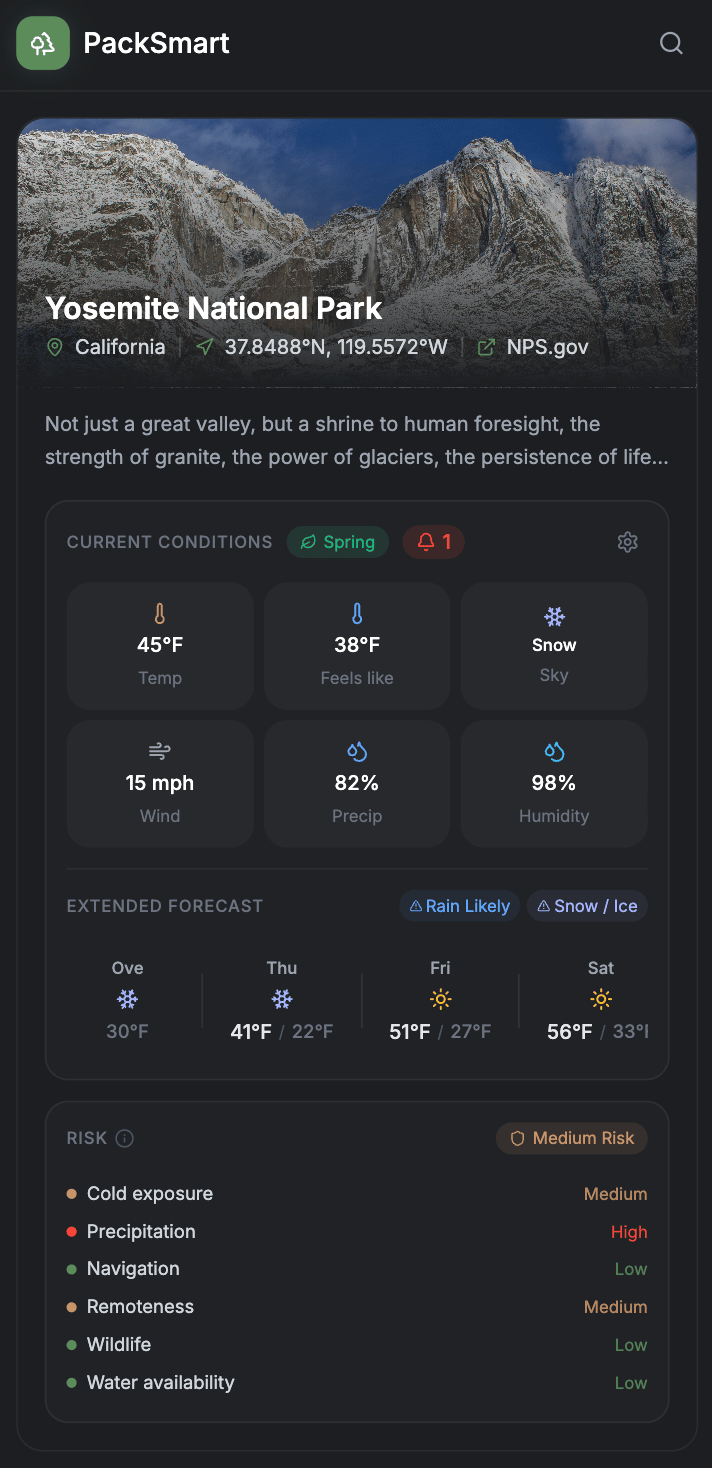
A location-aware packing assistant that helps hikers make safer, smarter gear decisions based on real-world conditions.

Explore PackSmart

button

button

Role:

Product Designer (End-to-End)

Responsibilities:

UX strategy, interaction design, data modeling, prototyping

Problem:

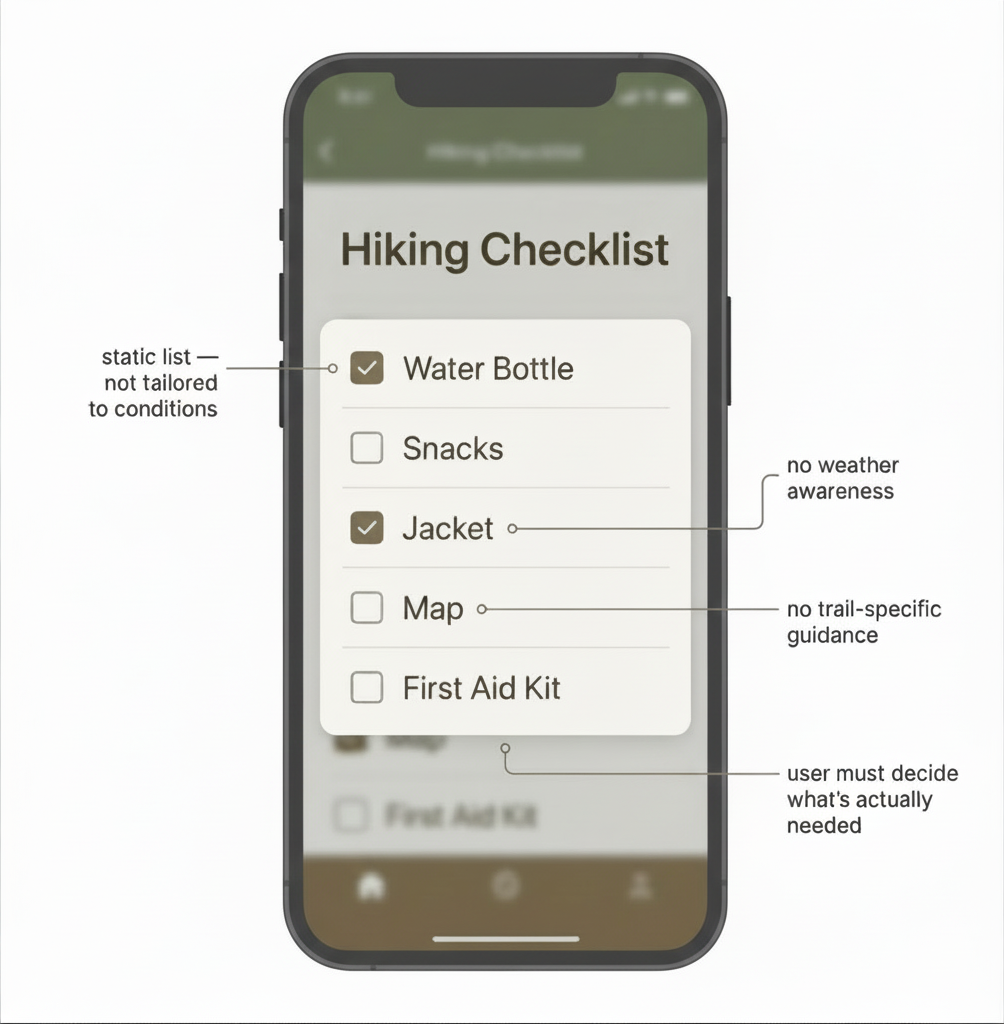
Hikers often rely on static checklists that don’t adapt to weather, terrain, or trip conditions, increasing risk and overpacking.

Solution:

A context-aware system that generates dynamic gear recommendations using park, weather, and trail data.

Expected Impact:

More accurate packing decisions, reduced risk, and improved confidence for hikers through situational awareness.

My Contributions:

Defined product strategy, designed decision logic system, built end-to-end UX, and structured data-driven gear logic.
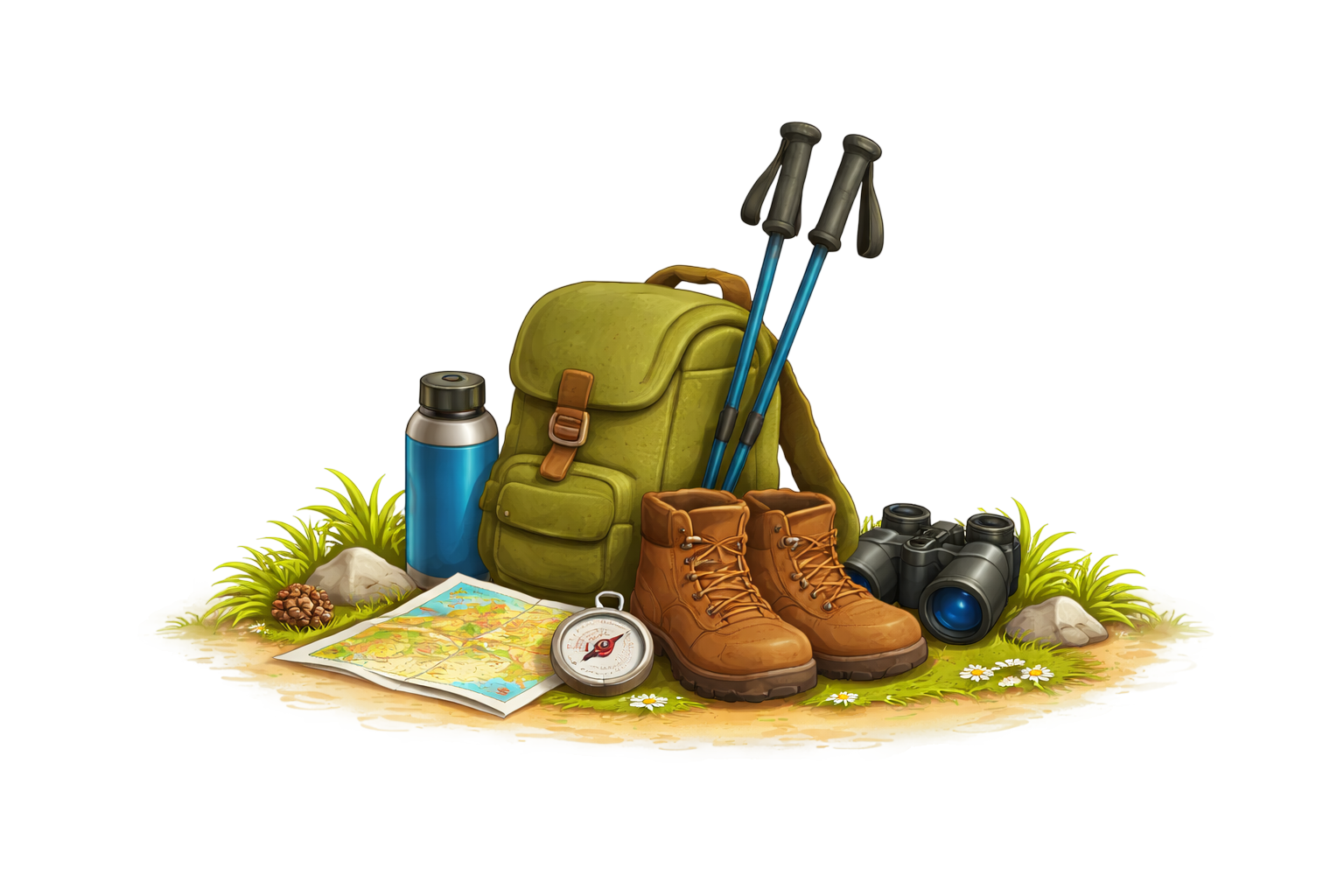
Problem & Context

Outdoor planning tools often stop at navigation or discovery, leaving users to interpret conditions and decide what to pack. This creates a gap between information and action.

For hikers, poor packing decisions can lead to:

  • Safety risks (weather exposure, lack of essentials)
  • Overpacking (fatigue, inefficiency)
  • Uncertainty before and during trips

From a product perspective, most tools (e.g., trail apps) optimize for exploration, not decision-making.

Constraints:

  • No access to proprietary trail APIs (e.g., Hiking Project deprecated)
  • Needed to rely on public APIs (NPS, weather.gov, OpenStreetMap)
  • MVP scope focused on logic and UX, not full map system

Stakeholders:

  • Solo project, but decisions were made with engineering feasibility and real-world product constraints in mind
Users & Insights

The research approach combined heuristic evaluation of existing outdoor apps, competitive analysis of apps like AllTrails, and secondary research on hiking preparation and safety. In addition, behavioral assumptions were formed based on common outdoor planning workflows to identify patterns in how users prepare for trips and make packing decisions.

Key Insights:

  • Tools provide data, not decisions - Users must interpret weather, terrain, and difficulty themselves.
  • Packing is context-dependent - The same trail requires different gear depending on conditions.
  • Safety is reactive, not proactive - Most apps surface alerts but don’t translate them into actions.
  • Cognitive load is high before trips - Users mentally map multiple inputs (weather, distance, elevation) into decisions.

Key Pain Points:

  • “What should I actually bring?”
  • Overpacking “just in case”
  • Missing critical gear due to lack of context

Strategy & Approach

Shift the experience from one where users must interpret information and make decisions themselves to one where the system interprets the information and guides users toward clear, actionable decisions.
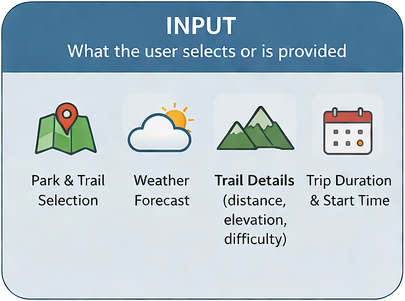
Core Hypothesis:

If the system translates environmental data into clear gear recommendations, users will make safer decisions, have reduced cognitive load, and pack more efficiently.

Design Principles:

  • Context over static lists
  • Safety-first recommendations
  • Clarity over complexity
  • Progressive disclosure (don’t overwhelm users)

Tradeoffs:

  • Avoided building full mapping system to focus on decision engine
  • Chose rule-based logic over ML for transparency and speed
  • Limited scope to national parks for controlled data input

Exploration & Iteration

Concept 1: Static Checklist

  • A traditional categorized gear list
  • Rejected because doesn’t adapt to context and no differentiation between trips

Concept 2: Filter Based System

  • Users manually select conditions (weather, difficulty)
  • Rejected because high cognitive load and requires user expertise

Concept 3: Automated Decision Engine

  • System interprets location and conditions. Then, outputs a gear list.
  • Iteration focus: simplifying inputs, making outputs actionable, and reducing decision friction

Final Solution

PackSmart delivers a location-aware packing experience: user selects a park, system fetches weather + conditions, and then, a gear list is dynamically generated.

Key Features:

  • Dynamic gear list - adapts based on weather conditions, trail difficulty and trip duration
  • Safety prioritization - highlights critical gear first
  • Weight tiers - supports standard, lightweight, and ultralight
  • Trigger-based logic:
    • e.g. Rain > 30% → Rain jacket
    • e.g. Temp < 45F → Insulation
    • e.g. Long hike → Extra Food

Why It Works:

  • Reduces decision-making burden
  • Translates data into action
  • Aligns with real-world hiking behavior

Expected Impact

Since this is a conceptual project, outcomes are based on UX principles and reasoning.

Expected Improvements

  • Reduced Cognitive Load - Users no longer interpret multiple data sources manually
  • Improved Safety - Critical gear is surfaced based on conditions
  • More Efficient Packing - Eliminates unnecessary items

Supporting Principles:

  • Recognition over recall
  • Contextual decision-making
  • Progressive disclosure

Validation Approach

What To Test

  • Accuracy of gear recommendations
  • User trust in system decisions
  • Clarity of UI and outputs

Methods

  • Moderated usability testing
  • Scenario-based testing (e.g., “rainy hike”)
  • A/B testing (static vs dynamic list)

Success Metrics

  • Task success rate
  • Time to finalize packing list
  • User confidence rating
  • Error rate (missing critical gear)

Role & Reflection

This was an end-to-end solo project. I was responsible for: product strategy, UX and interaction design, data modeling for gear logic, and API integration planning. I approached decisions with cross-functional thinking, considering: engineering feasibility, data constraints and scalability.

What I’d Improve:

  • Validate gear logic with real hikers
  • Test trust in automated recommendations
  • Refine edge cases (extreme conditions)

Risk & Assumptions:

  • Assumes users trust system-generated recommendations
  • Rule-based logic may oversimplify complex scenarios

The key learning is that the biggest opportunity isn’t adding more data, but interpreting it in a way that drives clear, actionable decisions. Moving forward, the focus is on integrating trail-specific data—such as distance, elevation, and difficulty—to deepen the system’s contextual awareness and further improve the accuracy and usefulness of gear recommendations.

Mason Tavakoli

Say hi 👋 on

A location-aware packing assistant that helps hikers make safer, smarter gear decisions based on real-world conditions.

Explore PackSmart

button

button

Role:

Product Designer (End-to-End)

Responsibilities:

UX strategy, interaction design, data modeling, prototyping

Problem:

Hikers often rely on static checklists that don’t adapt to weather, terrain, or trip conditions, increasing risk and overpacking.

Solution:

A context-aware system that generates dynamic gear recommendations using park, weather, and trail data.

Expected Impact:

More accurate packing decisions, reduced risk, and improved confidence for hikers through situational awareness.

My Contributions:

Defined product strategy, designed decision logic system, built end-to-end UX, and structured data-driven gear logic.

Problem & Context

Outdoor planning tools often stop at navigation or discovery, leaving users to interpret conditions and decide what to pack. This creates a gap between information and action.

For hikers, poor packing decisions can lead to:

  • Safety risks (weather exposure, lack of essentials)
  • Overpacking (fatigue, inefficiency)
  • Uncertainty before and during trips

From a product perspective, most tools (e.g., trail apps) optimize for exploration, not decision-making.

Constraints:

  • No access to proprietary trail APIs (e.g., Hiking Project deprecated)
  • Needed to rely on public APIs (NPS, weather.gov, OpenStreetMap)
  • MVP scope focused on logic and UX, not full map system

Stakeholders:

  • Solo project, but decisions were made with engineering feasibility and real-world product constraints in mind

Users & Insights

The research approach combined heuristic evaluation of existing outdoor apps, competitive analysis of apps like AllTrails, and secondary research on hiking preparation and safety. In addition, behavioral assumptions were formed based on common outdoor planning workflows to identify patterns in how users prepare for trips and make packing decisions.

Key Insights:

  • Tools provide data, not decisions - Users must interpret weather, terrain, and difficulty themselves.
  • Packing is context-dependent - The same trail requires different gear depending on conditions.
  • Safety is reactive, not proactive - Most apps surface alerts but don’t translate them into actions.
  • Cognitive load is high before trips - Users mentally map multiple inputs (weather, distance, elevation) into decisions.

Key Pain Points:

  • “What should I actually bring?”
  • Overpacking “just in case”
  • Missing critical gear due to lack of context

Strategy & Approach

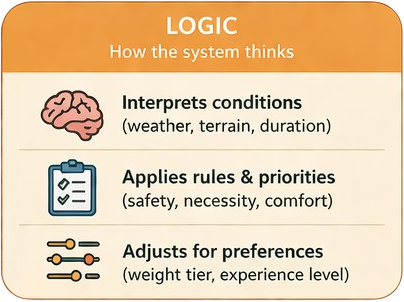
Shift the experience from one where users must interpret information and make decisions themselves to one where the system interprets the information and guides users toward clear, actionable decisions.
Core Hypothesis:

If the system translates environmental data into clear gear recommendations, users will make safer decisions, have reduced cognitive load, and pack more efficiently.

Design Principles:

  • Context over static lists
  • Safety-first recommendations
  • Clarity over complexity
  • Progressive disclosure (don’t overwhelm users)

Tradeoffs:

  • Avoided building full mapping system to focus on decision engine
  • Chose rule-based logic over ML for transparency and speed
  • Limited scope to national parks for controlled data input

Exploration & Iteration

Concept 1: Static Checklist

  • A traditional categorized gear list
  • Rejected because doesn’t adapt to context and no differentiation between trips

Concept 2: Filter Based System

  • Users manually select conditions (weather, difficulty)
  • Rejected because high cognitive load and requires user expertise

Concept 3: Automated Decision Engine

  • System interprets location and conditions. Then, outputs a gear list.
  • Iteration focus: simplifying inputs, making outputs actionable, and reducing decision friction

Final Solution

PackSmart delivers a location-aware packing experience: user selects a park, system fetches weather + conditions, and then, a gear list is dynamically generated.

Key Features:

  • Dynamic gear list - adapts based on weather conditions, trail difficulty and trip duration
  • Safety prioritization - highlights critical gear first
  • Weight tiers - supports standard, lightweight, and ultralight
  • Trigger-based logic:
    • e.g. Rain > 30% → Rain jacket
    • e.g. Temp < 45F → Insulation
    • e.g. Long hike → Extra Food

Why It Works:

  • Reduces decision-making burden
  • Translates data into action
  • Aligns with real-world hiking behavior

Expected Impact

Since this is a conceptual project, outcomes are based on UX principles and reasoning.

Expected Improvements

  • Reduced Cognitive Load - Users no longer interpret multiple data sources manually
  • Improved Safety - Critical gear is surfaced based on conditions
  • More Efficient Packing - Eliminates unnecessary items

Supporting Principles:

  • Recognition over recall
  • Contextual decision-making
  • Progressive disclosure

Validation Approach

What To Test

  • Accuracy of gear recommendations
  • User trust in system decisions
  • Clarity of UI and outputs

Methods

  • Moderated usability testing
  • Scenario-based testing (e.g., “rainy hike”)
  • A/B testing (static vs dynamic list)

Success Metrics

  • Task success rate
  • Time to finalize packing list
  • User confidence rating
  • Error rate (missing critical gear)

Role & Reflection

This was an end-to-end solo project. I was responsible for: product strategy, UX and interaction design, data modeling for gear logic, and API integration planning. I approached decisions with cross-functional thinking, considering: engineering feasibility, data constraints and scalability.

What I’d Improve:

  • Validate gear logic with real hikers
  • Test trust in automated recommendations
  • Refine edge cases (extreme conditions)

Risk & Assumptions:

  • Assumes users trust system-generated recommendations
  • Rule-based logic may oversimplify complex scenarios

The key learning is that the biggest opportunity isn’t adding more data, but interpreting it in a way that drives clear, actionable decisions. Moving forward, the focus is on integrating trail-specific data—such as distance, elevation, and difficulty—to deepen the system’s contextual awareness and further improve the accuracy and usefulness of gear recommendations.

Mason Tavakoli

PackSmart Logo

A location-aware packing assistant that helps hikers make safer, smarter gear decisions based on real-world conditions.

Explore PackSmart

button

button

Role:

Product Designer (End-to-End)

Responsibilities:

UX strategy, interaction design, data modeling, prototyping

Problem:

Hikers often rely on static checklists that don’t adapt to weather, terrain, or trip conditions, increasing risk and overpacking.

Solution:

A context-aware system that generates dynamic gear recommendations using park, weather, and trail data.

Expected Impact:

More accurate packing decisions, reduced risk, and improved confidence for hikers through situational awareness.

My Contributions:

Defined product strategy, designed decision logic system, built end-to-end UX, and structured data-driven gear logic.

Graphic of hiking gears

Problem & Context

Outdoor planning tools often stop at navigation or discovery, leaving users to interpret conditions and decide what to pack. This creates a gap between information and action.

For hikers, poor packing decisions can lead to:

  • Safety risks (weather exposure, lack of essentials)
  • Overpacking (fatigue, inefficiency)
  • Uncertainty before and during trips

From a product perspective, most tools (e.g., trail apps) optimize for exploration, not decision-making.

Constraints:

  • No access to proprietary trail APIs (e.g., Hiking Project deprecated)
  • Needed to rely on public APIs (NPS, weather.gov, OpenStreetMap)
  • MVP scope focused on logic and UX, not full map system

Stakeholders:

  • Solo project, but decisions were made with engineering feasibility and real-world product constraints in mind

Users & Insights

The research approach combined heuristic evaluation of existing outdoor apps, competitive analysis of apps like AllTrails, and secondary research on hiking preparation and safety. In addition, behavioral assumptions were formed based on common outdoor planning workflows to identify patterns in how users prepare for trips and make packing decisions.

Key Insights:

  • Tools provide data, not decisions - Users must interpret weather, terrain, and difficulty themselves.
  • Packing is context-dependent - The same trail requires different gear depending on conditions.
  • Safety is reactive, not proactive - Most apps surface alerts but don’t translate them into actions.
  • Cognitive load is high before trips - Users mentally map multiple inputs (weather, distance, elevation) into decisions.

Key Pain Points:

  • “What should I actually bring?”
  • Overpacking “just in case”
  • Missing critical gear due to lack of context

Strategy & Approach

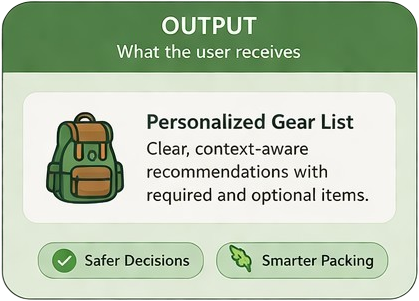
Shift the experience from one where users must interpret information and make decisions themselves to one where the system interprets the information and guides users toward clear, actionable decisions.
Core Hypothesis:

If the system translates environmental data into clear gear recommendations, users will make safer decisions, have reduced cognitive load, and pack more efficiently.

Design Principles:

  • Context over static lists
  • Safety-first recommendations
  • Clarity over complexity
  • Progressive disclosure (don’t overwhelm users)

Tradeoffs:

  • Avoided building full mapping system to focus on decision engine
  • Chose rule-based logic over ML for transparency and speed
  • Limited scope to national parks for controlled data input

Exploration & Iteration

Concept 1: Static Checklist

  • A traditional categorized gear list
  • Rejected because doesn’t adapt to context and no differentiation between trips

Concept 2: Filter Based System

  • Users manually select conditions (weather, difficulty)
  • Rejected because high cognitive load and requires user expertise

Concept 3: Automated Decision Engine

  • System interprets location and conditions. Then, outputs a gear list.
  • Iteration focus: simplifying inputs, making outputs actionable, and reducing decision friction
Final Solution

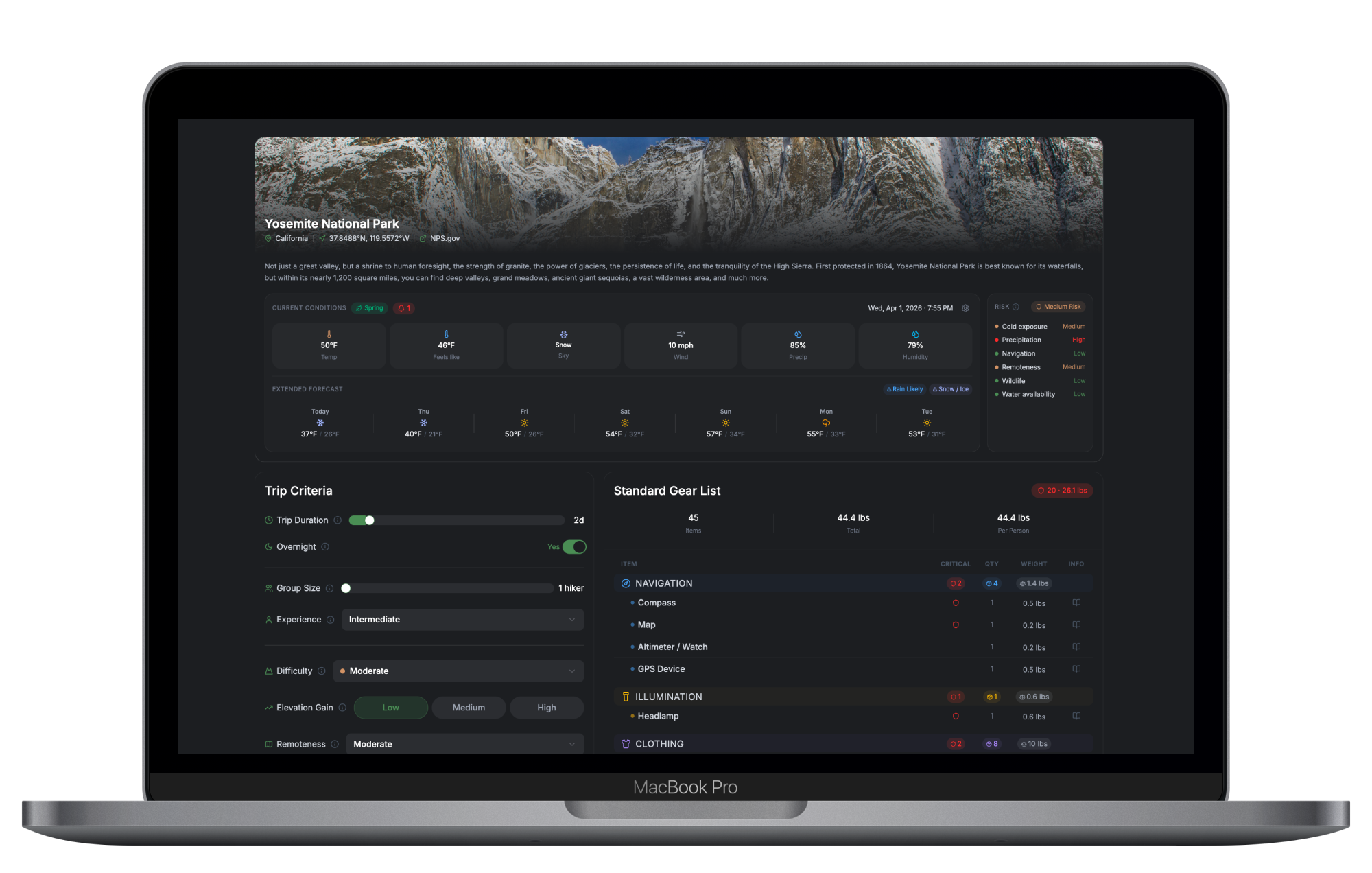
PackSmart delivers a location-aware packing experience: user selects a park, system fetches weather + conditions, and then, a gear list is dynamically generated.

Key Features:

  • Dynamic gear list - adapts based on weather conditions, trail difficulty and trip duration
  • Safety prioritization - highlights critical gear first
  • Weight tiers - supports standard, lightweight, and ultralight
  • Trigger-based logic:
    • e.g. Rain > 30% → Rain jacket
    • e.g. Temp < 45F → Insulation
    • e.g. Long hike → Extra Food

Why It Works:

  • Reduces decision-making burden
  • Translates data into action
  • Aligns with real-world hiking behavior

Expected Impact

Since this is a conceptual project, outcomes are based on UX principles and reasoning.

Expected Improvements

  • Reduced Cognitive Load - Users no longer interpret multiple data sources manually
  • Improved Safety - Critical gear is surfaced based on conditions
  • More Efficient Packing - Eliminates unnecessary items

Supporting Principles:

  • Recognition over recall
  • Contextual decision-making
  • Progressive disclosure

Validation Approach

What To Test

  • Accuracy of gear recommendations
  • User trust in system decisions
  • Clarity of UI and outputs

Methods

  • Moderated usability testing
  • Scenario-based testing (e.g., “rainy hike”)
  • A/B testing (static vs dynamic list)

Success Metrics

  • Task success rate
  • Time to finalize packing list
  • User confidence rating
  • Error rate (missing critical gear)

Role & Reflection

This was an end-to-end solo project. I was responsible for: product strategy, UX and interaction design, data modeling for gear logic, and API integration planning. I approached decisions with cross-functional thinking, considering: engineering feasibility, data constraints and scalability.

What I’d Improve:

  • Validate gear logic with real hikers
  • Test trust in automated recommendations
  • Refine edge cases (extreme conditions)

Risk & Assumptions:

  • Assumes users trust system-generated recommendations
  • Rule-based logic may oversimplify complex scenarios

The key learning is that the biggest opportunity isn’t adding more data, but interpreting it in a way that drives clear, actionable decisions. Moving forward, the focus is on integrating trail-specific data—such as distance, elevation, and difficulty—to deepen the system’s contextual awareness and further improve the accuracy and usefulness of gear recommendations.